When a card processor stops serving your business, many companies turn to crypto. That’s the right move — but only if it’s backed by the right infrastructure.
There’s a common story we hear from merchants during onboarding.
Stripe or PayPal stops processing — sometimes with notice, sometimes without explanation. The business looks for alternatives, finds a crypto gateway, integrates it. A few months later, the finance team is manually reconciling transactions in a blockchain explorer, customers are contacting support asking “did my payment go through?”, and fees vary from one transaction to another.
The problem isn’t crypto. The problem is that many treat switching to USDT as changing a payment rail — rather than implementing a payment infrastructure. Those are fundamentally different things, with different requirements.
In this article, we’ll break down what it actually takes for a USDT checkout to function as an operational tool — not a source of manual work.
What we’ll cover:
- why crypto ≠ a solution on its own
- how to choose the right infrastructure
- a 10-point checklist
- FAQ based on real merchant pain points
Chargebacks and account freezes are expensive — USDT removes the first, not the second
For high-risk and cross-border businesses, dependence on card processors isn’t an abstract risk — it’s a direct line item in operating costs. Account freezes, chargebacks, restrictions by geography, business category, and transaction size.
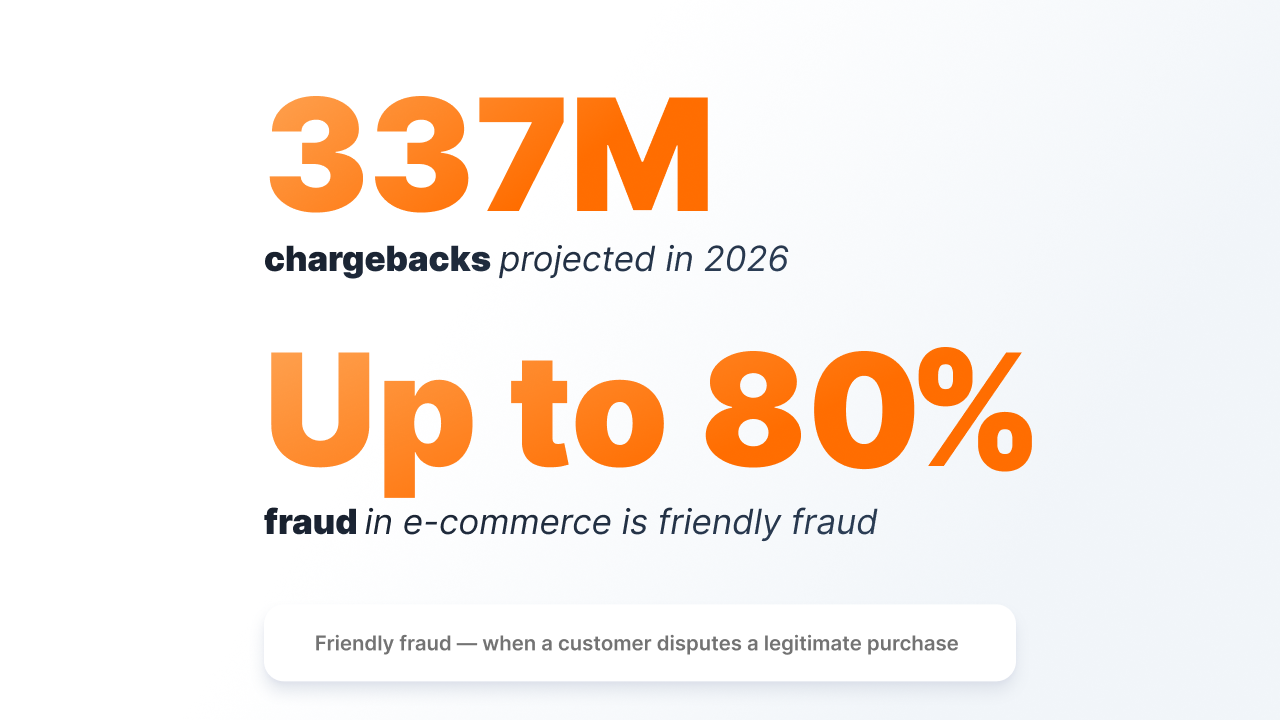
Crypto transactions are irreversible by design — the traditional chargeback mechanism simply doesn’t exist. This isn’t a marketing claim, it’s a property of blockchain systems. That’s why, for iGaming, digital goods, and cross-border platforms, adding USDT as a payment method has clear operational value.
At the same time, it’s important to understand: this is about reducing dependence on card processors. A crypto gateway can still suspend service or change its terms. The real question is: how diversified your payment stack is, and how predictable each part of it is.
USDT fixes the exchange rate and removes chargebacks — but only if the user already has a wallet
USDT is a stablecoin pegged to the US dollar. Unlike Bitcoin or Ethereum, its price doesn’t fluctuate throughout the day. For a merchant, this means the amount received is equal to the amount sent — with no volatility adjustment.
But there’s one critical limitation that is often overlooked when evaluating this setup: a crypto checkout is not a fiat on-ramp. The user must already hold USDT in their wallet. The checkout simply provides a structured payment page — it does not convert fiat into crypto and does not create a wallet for the user.
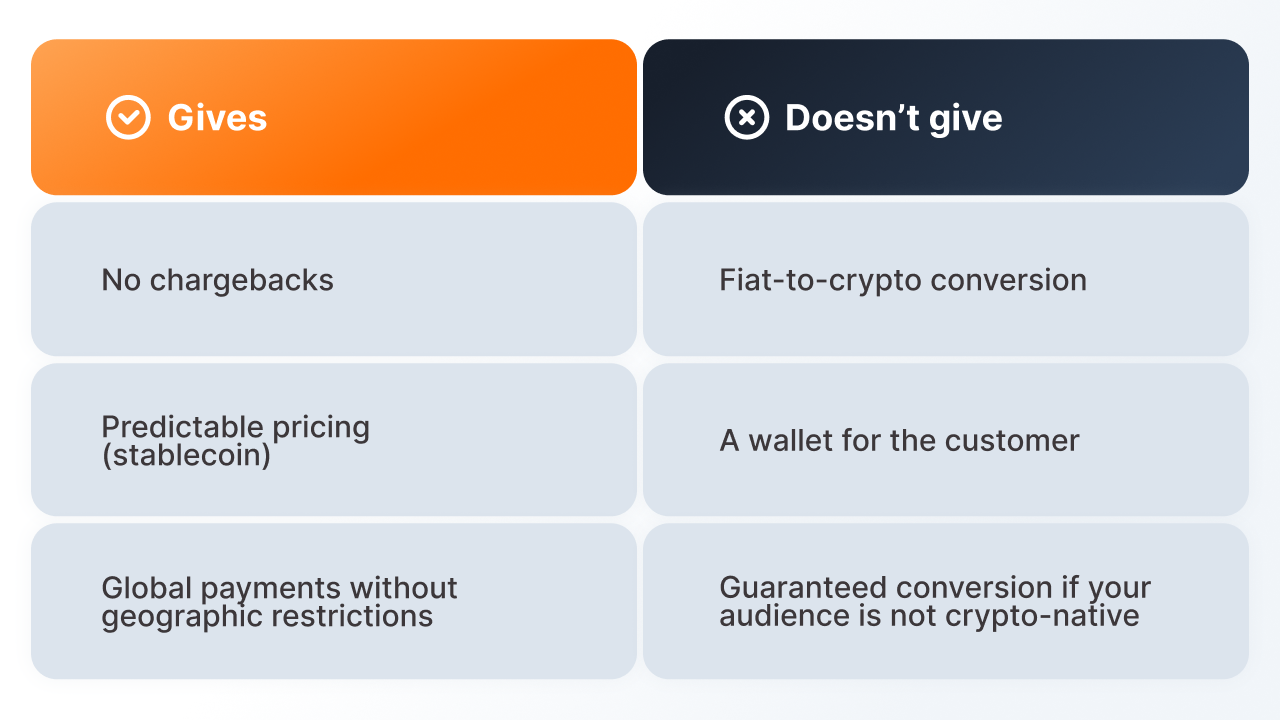
This means the effectiveness of USDT as a payment rail directly depends on whether your audience already uses crypto wallets.
One merchant described it like this: after seven years of accepting crypto via Shopify — zero transactions. Not because the tool didn’t work, but because the audience wasn’t there. USDT performs best where users are already crypto-native: iGaming, digital goods, and cross-border platforms.
One wallet address for everyone — and your finance team spends up to 10 hours a week on manual reconciliation
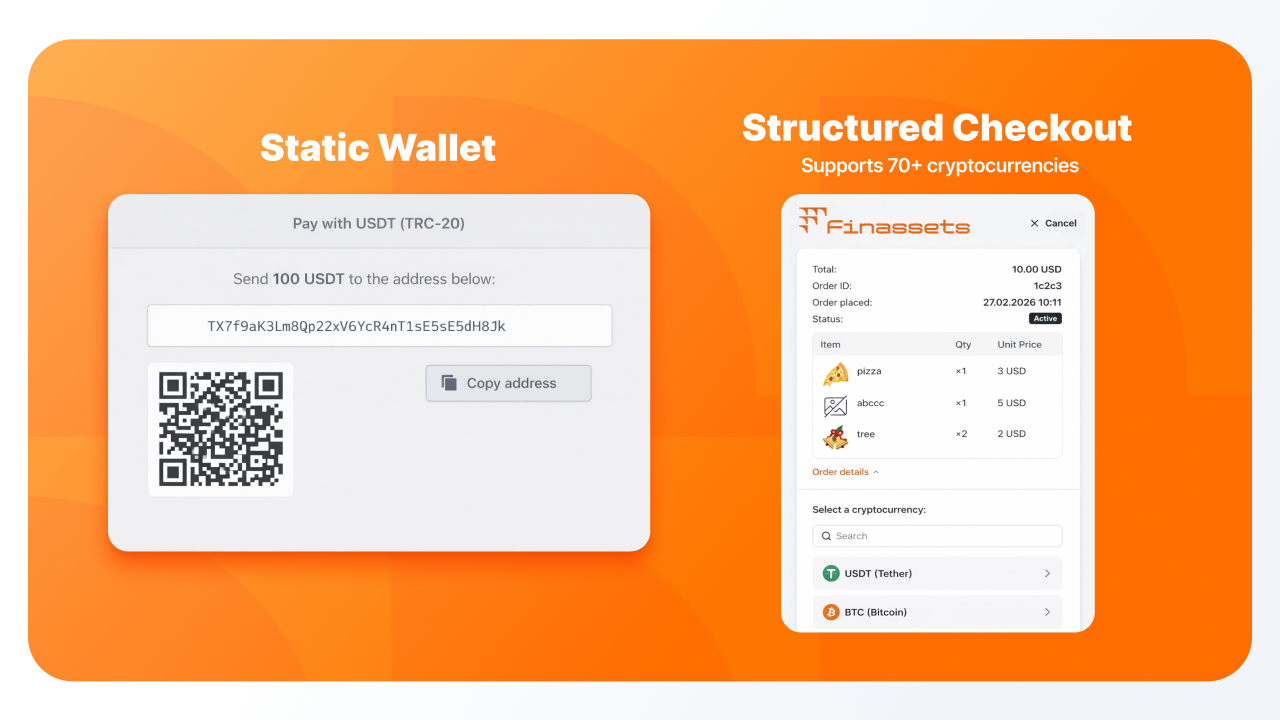
The most common first step when launching crypto payments is adding a single static wallet address to the website. Technically, it works: funds arrive. Operationally, it turns into what finance teams usually call “manual hell.”
|
Static wallet |
Structured checkout |
|
|
Address |
One for all payments |
Unique per session |
|
Transaction tracking |
Manual via blockchain explorer |
Automatic |
|
Payment status |
Not available |
Real-time |
|
Order matching |
Manual |
Automatic |
|
Partial payments |
Not tracked |
Tracked in Back Office |
|
Manual reconciliation |
Up to 10 hrs/week per staff member |
Not required |
There’s another scenario that happens regularly in practice:
a customer sends a payment, the checkout session expires due to timeout, the merchant receives the funds — but the order is never updated. The customer contacts support, and the team has to investigate manually. Each such case means time, cost, and reputational risk.
In reality, it can get even more complex: the transaction is confirmed on-chain, funds are delivered to the checkout address — but the order still doesn’t update. The provider points to a processing partner, the partner redirects back to the provider. The merchant ends up accountable to the customer, even though the payment technically went through. This exact scenario is one of the most common reasons merchants switch providers.
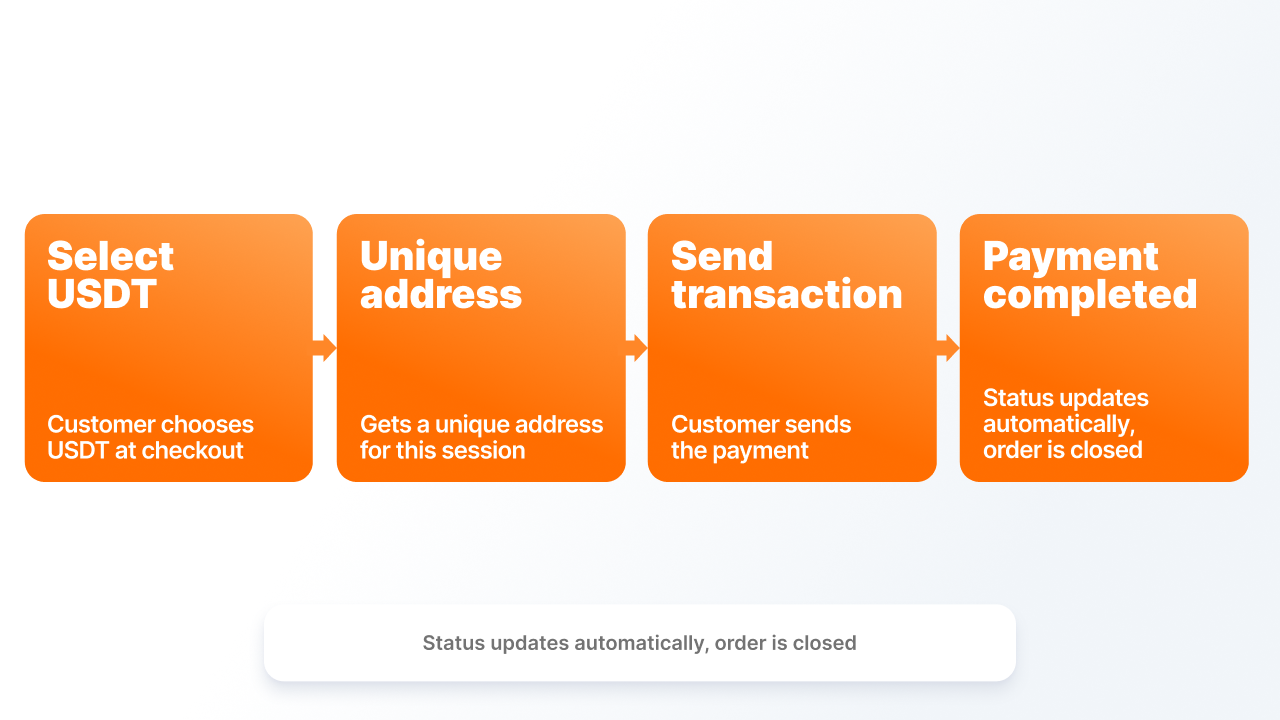
A structured checkout solves this by assigning a unique address to each session, automatically tracking payment statuses, and linking the transaction to the order — without any manual involvement.
No dev team — go with checkout-only. High volume and custom logic — use API
There are two integration paths, and the choice depends on your transaction volume and internal technical resources.
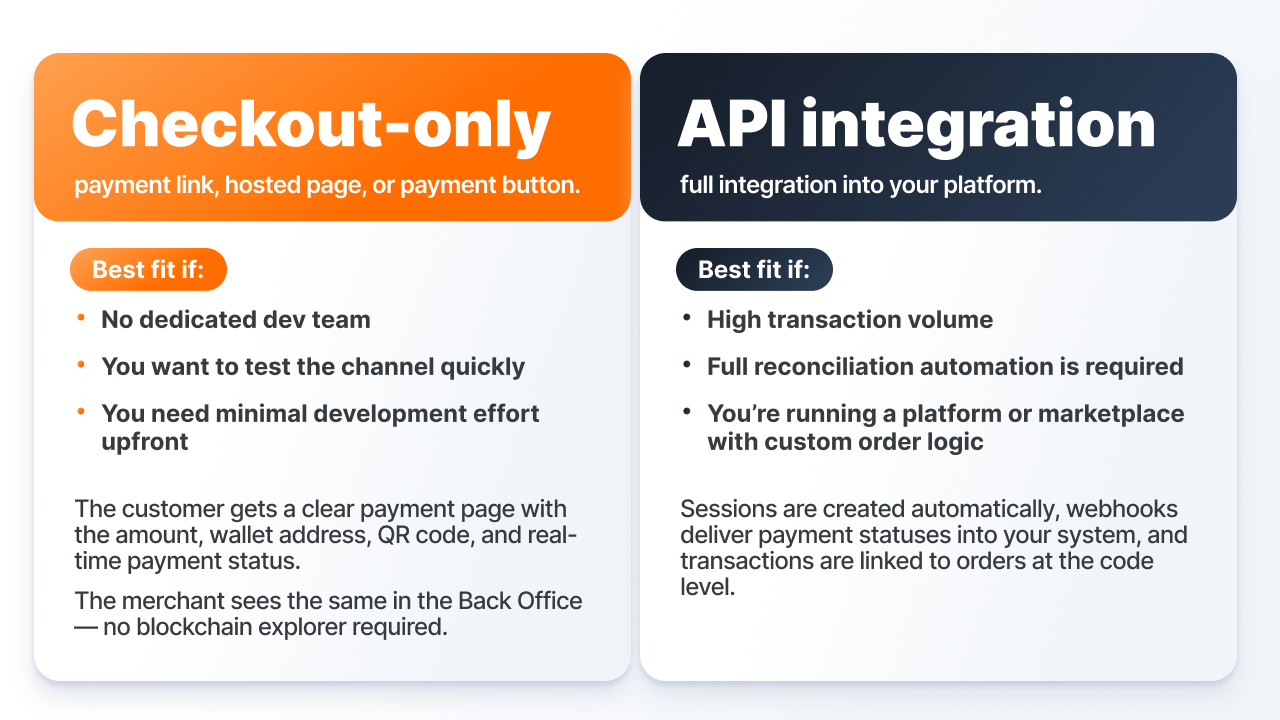
One practical note: having a sandbox environment and proper documentation is a must when evaluating any provider. Without the ability to test the integration before going live, it’s impossible to predict how the system will behave in edge cases.
→ Crypto Payment Gateway API — for high-volume businesses
Merchants see the status of every payment in real time — no blockchain explorer needed
The difference between “just a wallet” and a professional checkout provider comes down to operational visibility. A merchant shouldn’t need to open external tools to understand whether a payment went through — or which order it belongs to.
In the Finassets Back Office, merchants get:
- Real-time status for every transaction
- Full history of all checkout sessions
- Tracking of partial payments — when a customer sends less than the requested amount
- A single monitoring interface without cross-checking external sources
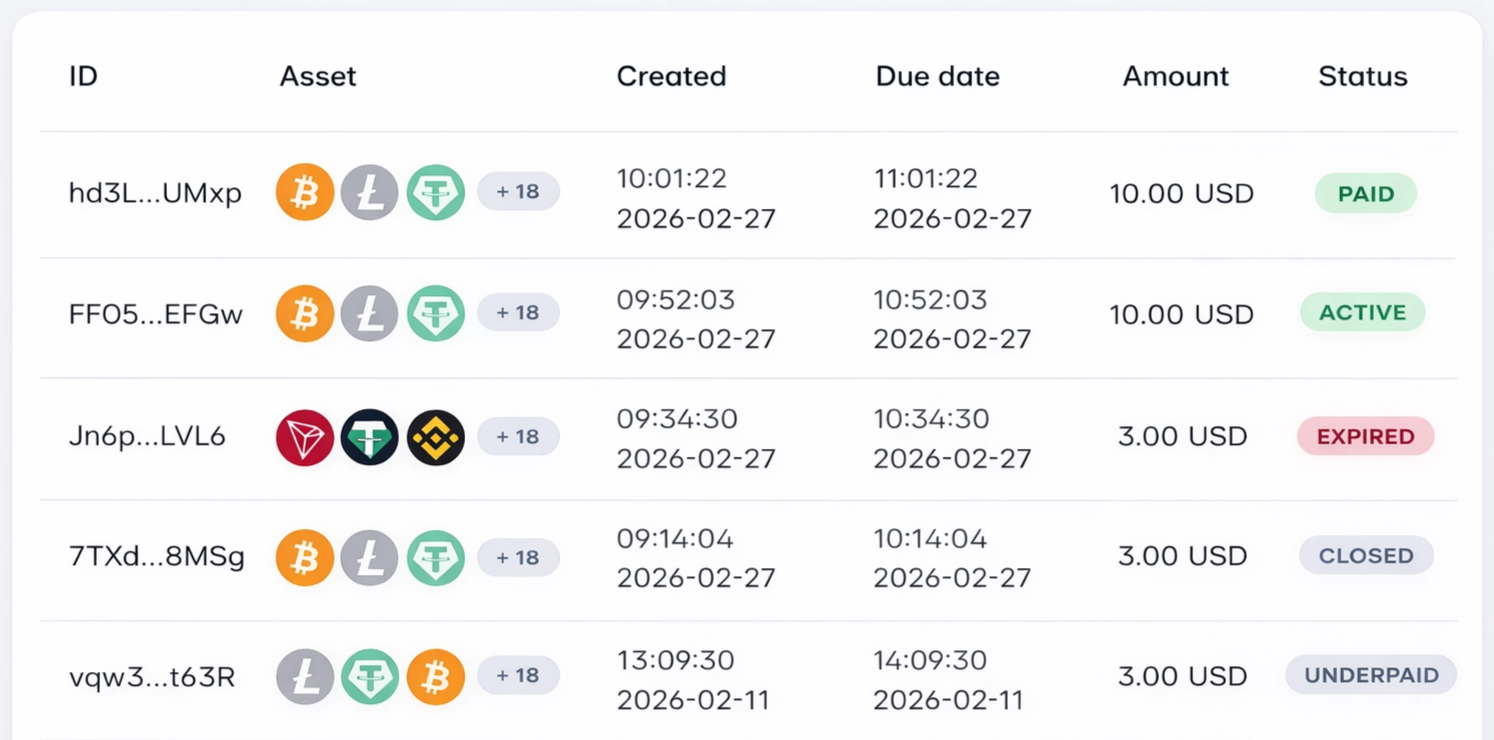
In practice, this delivers measurable results. A multi-brand online casino reduced finance team operational costs by 70% after implementing Finassets — not by reducing headcount, but by eliminating time spent on manual reconciliation.
→ Case study: how a marketplace reduced costs by 50% and improved transaction stability
TRC-20 is the industry standard — but not the cheapest. The real question is how you manage its cost
TRC-20 has become the de facto standard for USDT payments in iGaming because it’s fast, predictable, and widely supported by user wallets. The standard fee (via TRX burn) currently ranges from $1.92 to $4 per transaction — and increases with the price of TRX. At scale, this becomes a noticeable line in operating costs.
Another issue is fee transparency. In the crypto checkout market, it’s common for the final amount to differ from what was initially shown — without warning.
For merchants, this creates a double risk:
- margins become unpredictable
- customers blame the merchant, not the provider, when amounts don’t match
The difference lies in how the provider manages this cost. The standard approach — burning TRX per transaction — results in a variable fee that merchants only see after the fact.
Finassets uses pre-purchased Energy on the TRON network. This allows the fee to be fixed before transaction confirmation — independent of the current TRX price. At high transaction volumes, the difference between these two approaches becomes significant.
|
Standard mechanism |
Finassets |
|
|
Mechanism |
TRX burn |
Pre-purchased Energy on TRON |
|
Transaction cost |
Variable |
Predictable |
|
Fee visibility |
Post-factum |
Before confirmation |
iGaming, digital goods, high-risk, and cross-border — for standard e-commerce, conversion will be near zero
Crypto checkout is a niche tool with very specific conditions for effectiveness.
It works when several factors align:
- Your audience already holds USDT and is comfortable paying in crypto
- Your business operates in a high-risk or cross-border vertical
- There is a real need to diversify your payment stack
For a typical e-commerce store with a card-based audience, USDT conversion will be close to zero.
This is not a checkout problem — it’s a mismatch between the tool and the audience.
For high-risk verticals, predictability of provider terms is critical. Sudden gateway shutdowns without explanation are common in the market — especially in iGaming and digital goods. That’s why payment stack diversification is not optional — it’s an operational necessity.
Verticals where USDT solves a real operational need:
- iGaming and online casinos
- Platforms selling digital goods
- High-risk merchants
- Cross-border e-commerce with crypto-native users
Integration checklist: 10 things to verify before going live
- Confirm that your target audience has USDT wallets
- Choose the integration type: checkout-only or API
- Request sandbox access and test before launch
- Verify the Back Office includes real-time statuses and session history
- Ensure each session gets a unique wallet address
- Set up webhooks for automatic status updates
- Test how the system handles partial payments
- Clarify fee mechanics: fixed or variable, and whether fees are shown before confirmation
- Test behavior when a session times out
- Confirm KYC requirements — whether end-user verification is required
Next step
If you’re evaluating a USDT checkout for your business, start with specific operational questions to the provider: how the Back Office is structured, how partial payments are handled, whether a sandbox is available for testing, and how the fee mechanics work.
The Finassets team is ready to review your use case — no obligations.
→ finassets.io/en/contact/