

By Katerina V., payments content, covering crypto processing for iGaming and eCommerce operators.
Updated: 2026-07-09
A payment solutions consultant introduces an online casino operator to a PSP, the deal closes, and the merchant starts processing transactions. In the past, this kind of introduction ended with a one-time kickback and a handshake. Over the last three years, the affiliate channel in the iGaming ecosystem has evolved from an informal add-on into a distinct layer of commercial infrastructure, with formal contracts and defined payout terms.
This article covers a market map of agent programs with real figures and terms, a comparison of reward mechanics, and a practical checklist before signing any agreement.
Why informal kickbacks became formal rev-share agreements
Before 2022–2023, most agent fees in iGaming existed in a gray area: verbal agreements, cash or crypto transfers with no documentation. Today, the market has moved toward formal contracts with defined payouts, for three main reasons.
Crypto adoption reduced friction in settlements. Stablecoin payments via TRC-20 or ERC-20 made international affiliate payouts technically simpler, with no bank wires and no multi-day delays. Competition also moved into the affiliate channel: as direct sales and digital marketing hit saturation, payment providers started buying ready merchant leads through industry connections, turning the affiliate network into an acquisition channel with a measurable customer acquisition cost. And CAC optimization pushed the market toward pay-for-performance, since the cost of acquiring a B2B client in iGaming keeps rising, and revenue share from a confirmed merchant is more cost-efficient than media reach: money only goes out after the client starts processing transactions.
Who sells partnerships today: three layers of the market
The market has split into three layers. Operator affiliate programs are the classic B2C traffic channel with RevShare, CPA, and Hybrid models, offering the highest headline percentages, sometimes up to 45% of net gaming revenue, and the most complex deductions. PSP and crypto processing programs introduce B2B clients, meaning merchants, to a payment provider, with the percentage calculated from the provider's fee or margin and typically a lifetime tail. Ecosystem programs cover game providers, licensing brokers, white-label platforms, and SaaS; public rates are rarely disclosed, but the channel itself is built into B2B distribution strategy, and several major platform vendors in the space have launched affiliate or referral modules as standalone commercial products.
The same percentage applied to different bases produces very different real income
Before comparing percentages, it's important to understand that the same "20%" applied to different bases produces very different real income. This is the main trap in the agent market.
How reward structures actually work: the same percentage means different money
Before comparing percentages, it is important to understand: the same "20%" applied to different bases produces very different real income. This is the main trap in the agent market.
|
Provider |
Rate |
Calculation Base |
Duration |
|
NOWPayments |
25% |
from the service fee |
5 years |
|
1xPartners |
Up to 45% |
NGR (net gaming revenue, after defined deductions) |
Lifetime |
|
Stake |
variable (commonly ~10%+) |
Theoretical hold / house edge on player volume |
Lifetime |
| Finassets | 40% (year 1), then 20% (years 2–6) | Processing fee | Up to 6 years per referral, term extendable based on merchant profile |
Three ways programs quietly reduce your payout
A haircut on the base: some programs calculate from their own profit margin rather than gross volume, and others calculate from theoretical hold rather than actual volume; the narrower the base, the lower the real payout at the same headline percentage.
A haircut on deductions: in operator-side programs, bonuses, chargebacks, refunds, PSP costs, FX spread, overrides, and negative carry may all be subtracted from the base, and in programs with a net-gaming-revenue base, the waterfall formula is often non-transparent and can be changed unilaterally.
And a haircut on payout mechanics: some industry programs set a minimum payout threshold with payout only in crypto, a weekly cutoff with a separate minimum, or the right to delay payment for a defined period for fraud verification, each of which can quietly reduce realized income even when the headline rate stays the same.
A dashboard is not the same as honest accounting
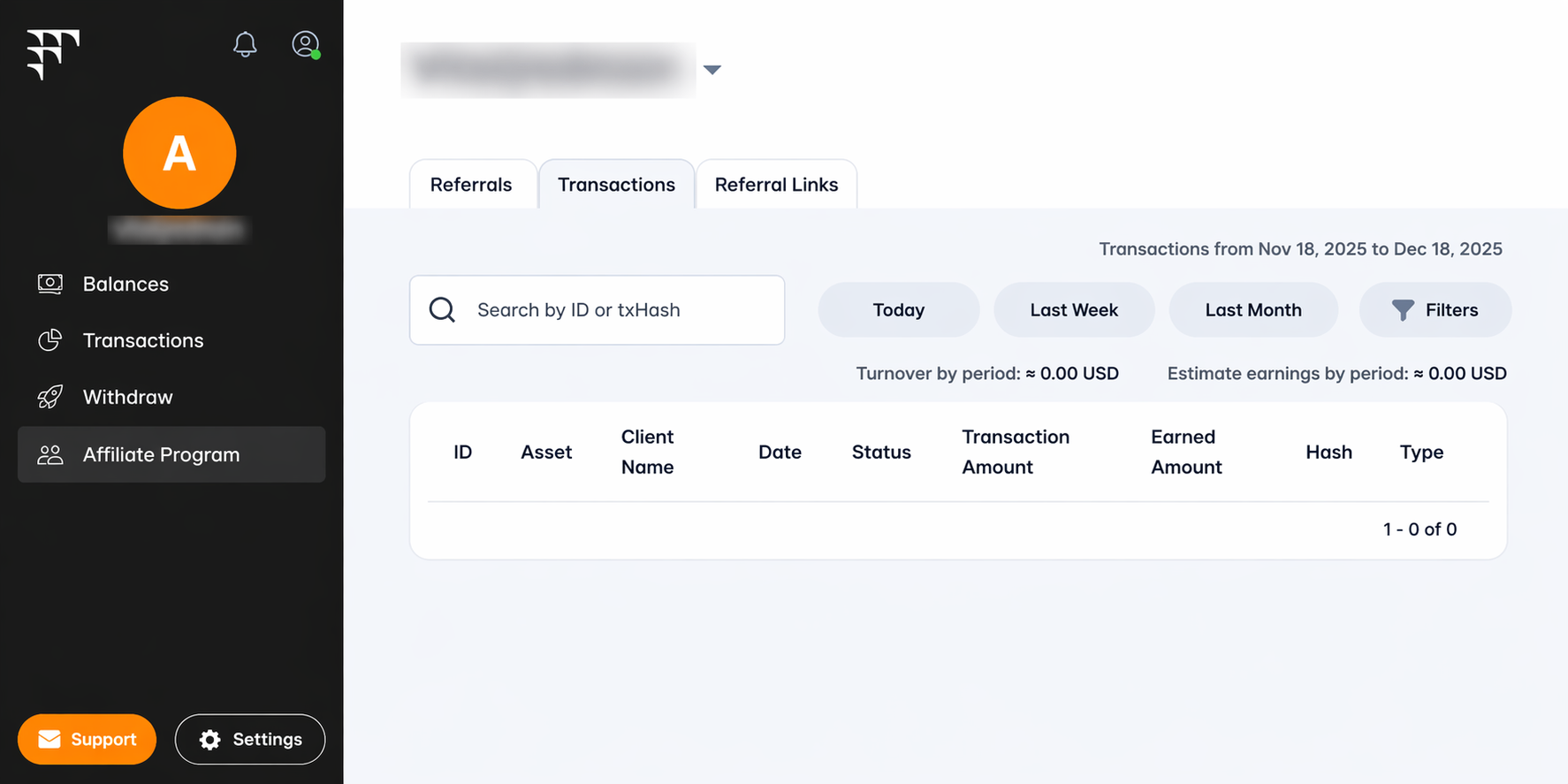
An affiliate dashboard displays metrics, but it doesn't guarantee that the data is complete, accurate, or calculated fairly. For an agent, this is critical: if the contract doesn't include audit rights and a clear definition of an attribution event, any dispute over which partner brought in a merchant gets resolved by the program, typically in its own favor.
Most programs put compliance liability on the partner without giving them the tools
In most affiliate programs, the boundary of partner responsibility is vague. A contract may require the affiliate to meet the same standards as the operator, hand over information on request, and, under a broadly defined "fraud traffic" clause, lose already-accrued payouts. Some programs on the market place de facto compliance risk on the partner while giving them no access to client KYC data and no tools to verify anything.
The Finassets contract follows a different logic: the partner introduces the client, and from that point the company takes over KYC/AML checks, approval decisions, and integration. The partner is only required not to refer to knowingly problematic structures.
What the contract must say: terms that directly affect your income
Most affiliate programs leave key terms to private negotiation or hide them in unilaterally changeable terms of service. A few points directly affect a partner's income, and here's how each is handled in the Finassets agreement specifically.
The commission base is fixed: the contract defines "Company's Transaction Fee" as the net fee retained by the company, after deducting blockchain fees, third-party processor fees, refunds, reversals, and taxes. The partner can see exactly what their commission is calculated from.
As of July 2026, Finassets pays 40% of the processing fee in the first year on a referred merchant, then 20% for five additional years while the merchant keeps processing, extending the total partner earning window to six years per referral, with the term extendable based on the merchant profile. Commission after termination is defined by scenario: if the company terminates without fault on the partner's side, commissions continue for the remainder of the earning window on all referred active clients; if the partner initiates termination, payouts continue on amounts already accrued up to the termination date; if termination is caused by a partner violation, payouts stop immediately. KYB and AML liability is clearly divided: the contract explicitly states that KYC/AML checks on clients remain exclusively with the company, and the partner is required to exercise commercially reasonable care when introducing clients, meaning they should not refer knowingly sanctioned or high-risk structures.
Where this doesn't apply
This market map is specifically about commercial affiliate and introducer programs in iGaming payments, not about referral bonuses for individual players or one-off finder's fee arrangements outside a formal program. It also assumes a partner is bringing in a meaningful, ongoing volume of referred clients; for a single one-off introduction, the difference between commission bases described here matters far less than it does for someone building a recurring referral business. And none of this changes the underlying regulatory reality: the regulator looks at the licensee, and no affiliate contract structure removes that.
Before you sign: questions every agent should ask
What is the commission calculated from? Gross volume, processing fee, net profit, or net gaming revenue after deductions all produce very different real money from the same 20–25% headline rate; ask for a written example calculation using a specific merchant.
What happens to payouts on termination? Most programs either don't answer this publicly or give a vague formulation; clarify whether payouts continue on referred clients if the company terminates the contract, and what happens if you terminate instead.
What counts as fraudulent traffic, and who decides? Some programs define fraud traffic so broadly that chargebacks, VPN use, and bonus abuse fall under it, events the partner has no control over; clarify the list of grounds for holds and clawbacks, and who makes the decision.
Who is responsible for client verification? If the contract requires the partner to meet the same AML standards as the provider but gives no access to KYC tools or data, that's a transfer of liability without real authority; the division should be clear about what's expected from the partner and what stays with the company.
Finassets affiliate program: transparent terms and ongoing partner commissions
Finassets approaches its partner program with a focus on transparent commercial terms. Commission conditions are defined in the agreement, and transaction activity can be monitored in real time through the dashboard. Finassets provides crypto payment infrastructure for operators, digital goods platforms, and other eligible online businesses, and under the affiliate program, partners may receive commission based on Finassets transaction fees generated by referred clients, subject to program terms and continued client activity.
In July 2026, Finassets doubled its first-year affiliate revenue share to 40%, with 20% continuing for five more years while the referred merchant keeps processing, extending the total partner earning window to six years per referral, with the term extendable based on the merchant profile.
| Monthly merchant volume | Finassets fee (0.4%) | Partner's share, year 1 (40%) | Partner's share, years 2–6 (20%) |
|---|---|---|---|
| $200,000 | $800 | $320/month | $160/month |
| $500,000 | $2,000 | $800/month | $400/month |
| $800,000 | $3,200 | $1,280/month | $640/month |
| $2,000,000 | $8,000 | $3,200/month | $1,600/month |
One active merchant at $800k volume means $1,280 a month in year one, then $640 a month for years two through six, with the term extendable based on the merchant profile.
Upon registration, a partner gets access to a personal Agent Dashboard, which includes wallet balances across assets with one-click withdrawal, a live commission feed showing every client, every transaction, and the partner's exact share in real time, referral tracking for managing, pausing, and cloning links with conversion tracking, and a withdrawals preview showing network fee calculation and net payout estimate before sending. This is an operational tool: the partner sees not just the bottom line, but which client, which volume, and which transactions generated the payout. Agent payouts are sent in crypto to any wallet on the day they're accrued.
The real value of a program is the base, the transparency, and the risk distribution
The value of an agent program in iGaming can't be measured by headline percentage alone. What matters is the commission base, attribution transparency, compliance risk distribution, and who controls changes to the terms. Programs that fix these variables in a contract give the partner predictable cash flow. Programs that hide the formula behind "up to X%" give the partner an option, where the other party controls execution. Treat any affiliate program as a legally manageable asset, or don't sign it.
If you have questions about the Finassets affiliate program, reach out at [email protected] or connect with Alona Kosolapova, COO at Finassets, on LinkedIn.