If the deposit "hangs" — the player will leave
Picture this: a player just hit a small win in demo mode. The impulse is there, the intent is there. They hit "Deposit", select USDT, get a wallet address — and wait. The screen doesn't change, no status update, no progress indicator. Forty seconds later, they close the tab.
The funds will probably arrive. But the player is already on another site. Technically, the transaction went through. Operationally, the deposit never happened.
This isn't a hypothetical. One operator we onboarded described it like this:
"If the deposit doesn't land in 5 seconds — that's fine. After 10 seconds, players start asking questions. After 30 seconds, they're nervous."
The problem isn't the blockchain. The problem is what the process looks like to the player at that exact moment. And for the operator, there's another side to it: the finance team is opening a blockchain explorer, manually searching for the transaction hash, and matching it to a player account. Sometimes that takes minutes. Sometimes hours. Based on what we see, without a structured checkout, manual reconciliation can consume up to 10 hours per week per finance team member.
Today let's talk about what separates a proper crypto checkout from a bad one — meaning a wallet address on a page. Five components that need to work if you want crypto deposits to become a genuine part of your casino's payment infrastructure, rather than a source of stress.
5 Must-Haves in a Proper Crypto Checkout
1. Speed — the kind players can see
Network speed and checkout speed are not the same thing. A TRC-20 transaction can confirm in under 3 seconds — but if the payment page doesn't update its status in real time, those 3 seconds feel like 40 to the player.
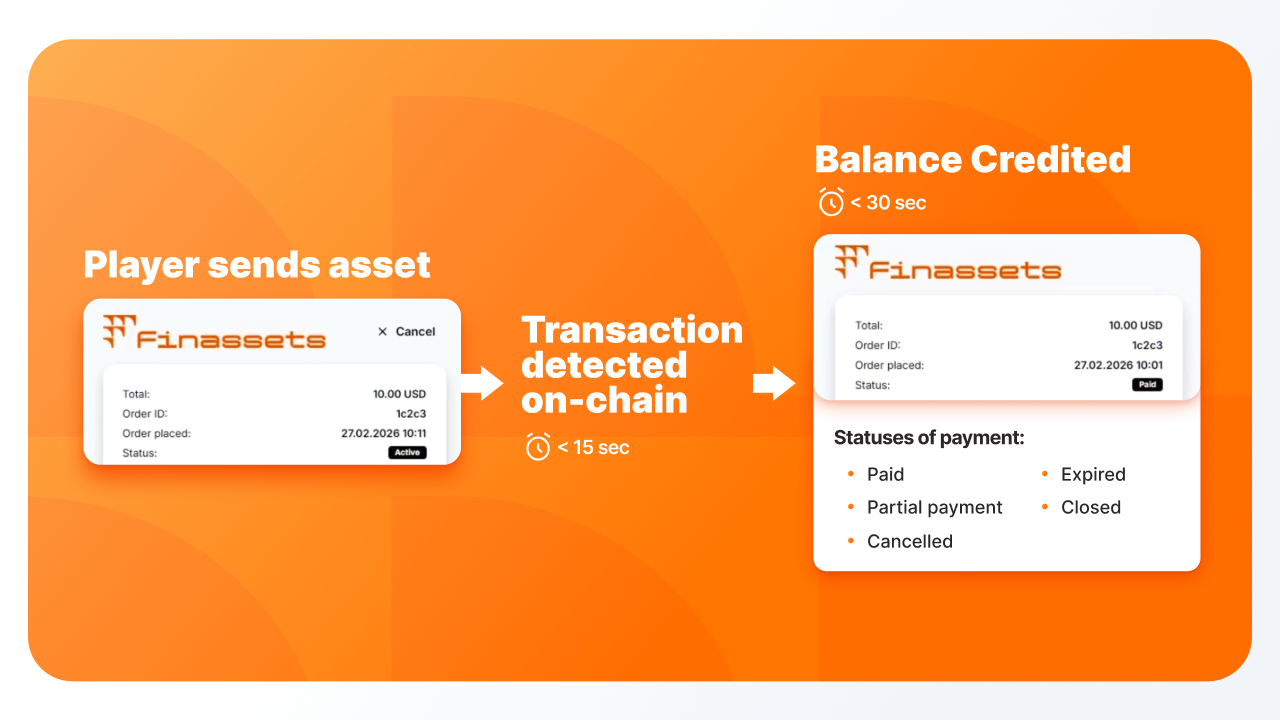
A proper checkout works like this: the player sends the transaction, and the page shows:
- "Transaction detected"
- "Confirming"
- "Balance credited"
Every step is visible. Every step reduces anxiety.
In iGaming this is especially critical: deposits often happen mid-session, when breaking that flow costs real money — for the player and the operator alike.
2. Visibility — transparency on both sides
Players need to know what's happening with their money right now. Operators need to see every transaction, its status, and its history — without opening a blockchain explorer.
A structured checkout gives operators a Back Office with clear logic: active sessions, completed payments, partial deposits, cancellations. The finance team sees everything in one place instead of juggling three different systems.
It was exactly this layer of automation that helped one of our clients — a multi-brand online casino — cut their finance department's operational costs by 70%. Not by reducing headcount, but by eliminating the time spent on manual reconciliation.
→ Case study: how an iGaming operator reduced operational costs by 70%
3. Gas Efficiency — total cost of ownership, not just the fee
Most operators look at the per-transaction fee as a fixed cost. That's the wrong way to think about it.
A better frame is total cost of ownership across the payment stack: network fees × transaction volume × deposit frequency.
TRC-20 is the standard for iGaming. But there's another optimization layer: instead of the standard TRX burn for gas, you can use pre-purchased Energy on the TRON network. This reduces the actual cost per transaction and makes fees predictable — which matters a lot at high deposit volumes.
A well-built checkout shows the player available networks and an estimated fee before they send. They choose for themselves — and that increases the likelihood of a repeat deposit.
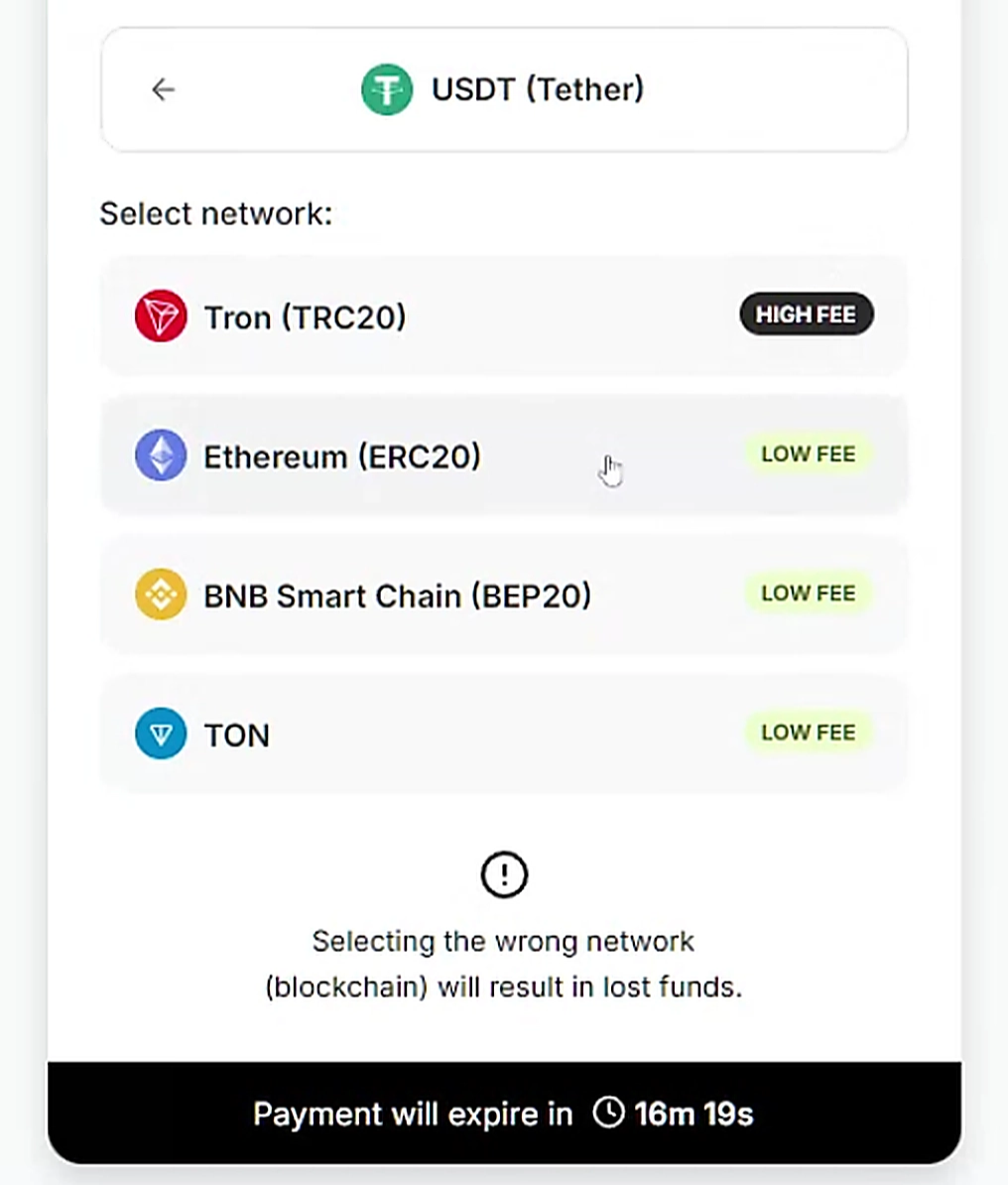
4. Parallel Setup — crypto as a second layer
The most common mistake when adding crypto payments is treating it as a replacement for existing methods. For many iGaming operators, crypto is an additional payment option — layered on top of cards and e-wallets without disrupting existing infrastructure.
A good checkout supports this model: players see crypto as one of the options on the deposit page, alongside card or PayPal. Switching between methods doesn't require a separate registration, a separate wallet, or a separate section of the site.
This matters operationally too: a checkout-only integration lets you add crypto without rebuilding your entire payment architecture. For operators who need deeper automation, API integration is available.
→ Crypto Payment Gateway API — for high-volume operators
5. High-Risk Readiness — the control iGaming actually requires
iGaming is high-risk by definition. Regulators, payment networks, banks — every counterparty in the ecosystem looks at this segment with elevated scrutiny. That means your payment infrastructure needs to be functional, predictable, and auditable.
For a crypto checkout in this context, several things become non-negotiable: clear payment status logic (including edge cases — partial payments, duplicate transactions), the ability to cancel or close a payment session, and — often underestimated — responsive support from your provider. When something goes wrong, operators need a response in minutes, not days.
SLA, transparent controls, and genuine support aren't upsells. In high-risk, they're baseline requirements.
Structured Checkout vs Basic Crypto Payment
Key differences across operationally critical parameters:
|
Parameter |
Basic Crypto Payment |
Structured Checkout |
|
Deposit speed |
30–120 sec, status unclear |
< 30 sec, real-time status visible |
|
Operator visibility |
Manual blockchain explorer checks |
Back Office: statuses, history, sessions |
|
Network fees |
Standard TRX burn |
TRC-20 Energy optimization |
|
Fiat integration |
Separate systems |
Parallel operation, unified interface |
|
High-risk controls |
No SLA, reactive support |
Partial payments, cancellation, SLA support |
|
Manual reconciliation |
Up to 10 hrs/week per staff |
Automated data transfer |
A structured checkout is about making deposits predictable for both the player and the operator.
When every step is visible and every transaction is tracked in real time, crypto stops being a source of uncertainty and becomes a reliable part of your payment infrastructure.
Next Step
If you're considering adding crypto alongside your existing payment methods — start with checkout-only. It's the fastest way to test the channel without rebuilding your payment architecture.
Related:
→ Crypto Payment Gateway API — for high-volume operators
→ Case study: 70% reduction in operational costs for a multi-brand casino